Two streams
Photos and videos live in separate tabs, so looking for a clip never means scrolling past a thousand stills.
See only what matters.
Private by design. All local.
Your memories stay on your device.
No accounts. No cloud.
Less UI. More of what matters.
Smooth, natural browsing.
A more thoughtful photo and video experience.
Your story. Yours alone.
Photos and videos.
Two streams. One focus. Yours.
Most galleries want to be everything — an editor, a social feed, a cloud service asking you to upgrade. Oryn does one thing. It shows you what is already on your phone, full screen, and then gets out of the way.
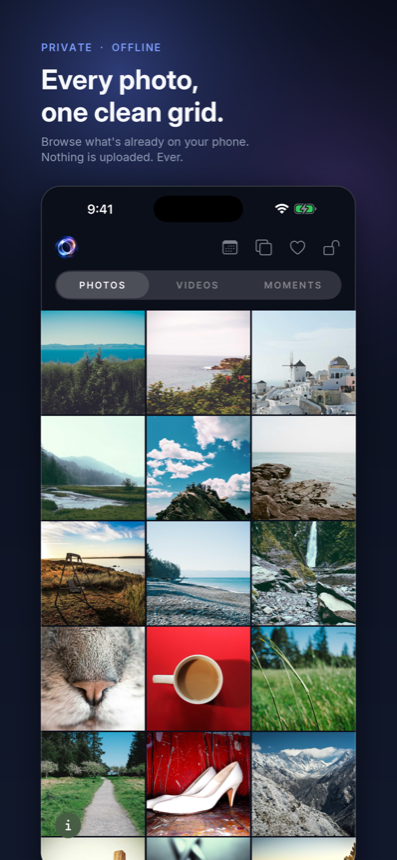
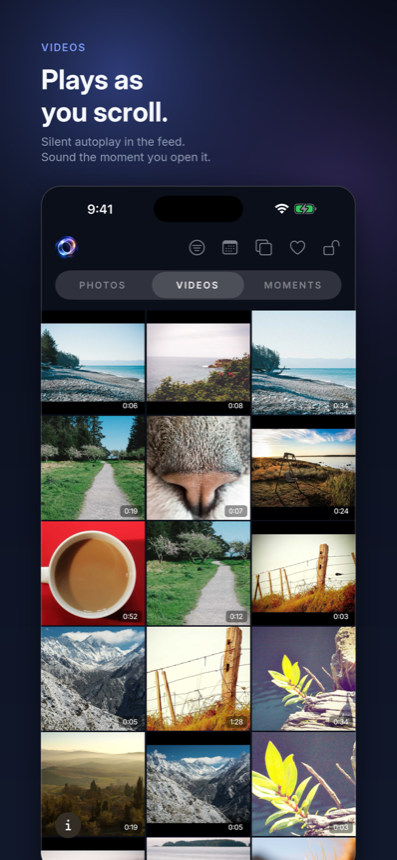
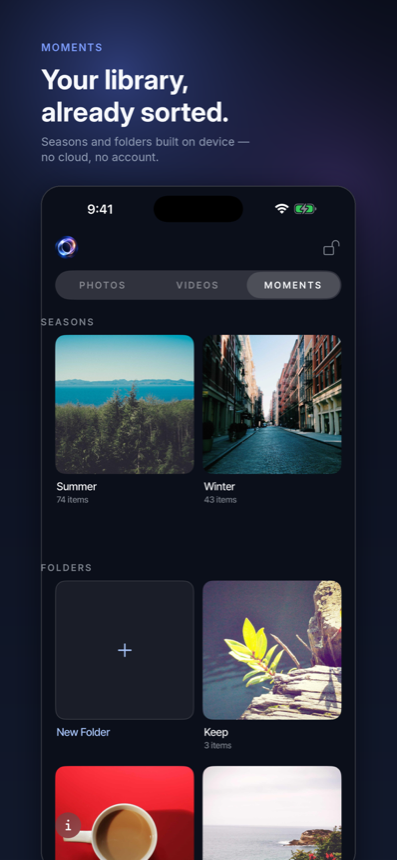
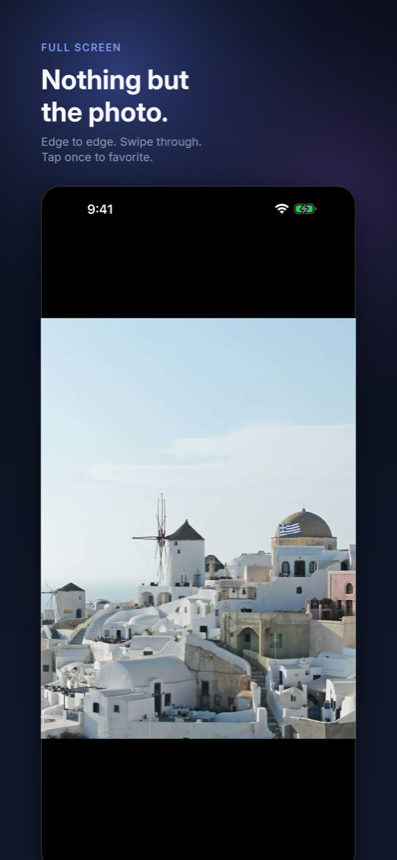
Photos and videos live in separate tabs, so looking for a clip never means scrolling past a thousand stills.
Your library groups itself by season, quietly, on the device. Make your own folders when the automatic ones aren't enough.
Face ID, Touch ID or your passcode in front of the whole app. Handing someone your phone stops being a decision.
Open a photo and the interface disappears. No chrome, no overlays, no buttons hovering over someone's face.
This isn't a policy position we might revisit next quarter. There is no server for your photos to go to, and the app has no code capable of sending them anywhere.
Everything is open for the first fortnight. After that the gallery stays free forever, and two extras ask for a single purchase.
The part you'll use every day, with no time limit and nothing asked of you.
No trial to expire. No card. No account.
A single non-consumable purchase. Buy it once, keep it on every device signed in to your Apple Account.
The App Store shows the price in your own currency. Not a subscription — there is nothing to cancel.
No. Your media is read from Apple's Photos framework on the device and drawn on screen. It is never copied, uploaded or backed up by us — there is no server of ours for it to reach.
The photo grid, the video stream and full-screen viewing stay free, permanently. Only Moments and the app lock ask for the one-time purchase. Nothing is charged automatically and there is no subscription.
Oryn deliberately will not pull media down from iCloud, because doing so would mean using the network for your library. Items stored only in iCloud won't appear. Opening one in Apple's Photos app brings it onto the device, and it then shows in Oryn.
It goes to your Recently Deleted album, exactly as it would from Apple's Photos app, and iOS keeps it there for 30 days. Oryn asks iOS to do the delete; it has no separate copy and no bin of its own.
We never see it. The lock asks iOS to authenticate you, and iOS answers yes or no. Your biometric data stays in the Secure Enclave, where even Apple cannot read it. If biometrics fail, your device passcode works.
iPhone and iPad running iOS 16 or later.
Oryn is coming to the App Store for iPhone and iPad.